
Vézanne, a France 3 report - Les Nouveaux Jours Productions
Antique earthenware becomes jewelry.
A France 3 report
 "Clélia perfectly embodies the spirit of Malicorne. Her unique creations are a living testament to the history of earthenware, transformed into contemporary jewelry. • ©Les Nouveaux Jours Productions."
The village of Malicorne-sur-Sarthe has been the cradle of a delicate and refined art for centuries: earthenware. It is here, in this picture-postcard setting, that a uniquely talented artist has chosen to settle down. Her name? Clélia. Her art? After working as a potter in Malicorne for several years, Clélia is now reinventing earthenware, giving it a new life, more beautiful and brilliant than ever.
The modern alchemist of earthenware
Imagine for a moment: a magnificent house, once inhabited by master potters, now a workshop brimming with creativity. It is here that Clélia Chotard works her magic, transforming old plates into unique jewels of breathtaking delicacy.
/regions/2025/01/09/visuel-article-9-677ff82228ad0830816177.jpg)
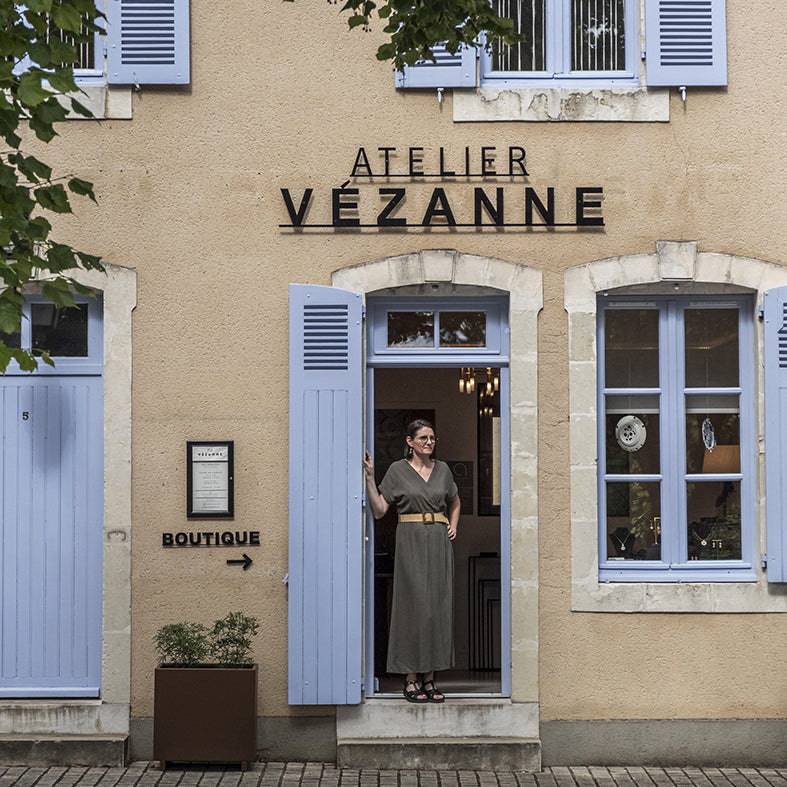
Clélia Chotard, creator of earthenware jewelry • © Les Nouveaux Jours Productions.
His creative process is a fascinating blend of respect for tradition and bold innovation.
"The plates and their fragments are my palette of colors."
Clélia, creator and craftswoman of earthenware jewelry.
" I need to live with them, to feel them around me before I can create ."
An art in twenty steps
Clélia's process is much more than simply transforming a plate into a piece of jewelry. It's a true metamorphosis requiring no fewer than twenty meticulous steps. From the initial selection of the plate to the gold-plated finish, each phase is executed with extreme care. Armed with her pencil, she isolates the motifs that inspire her. The cutting technique, in particular, remains Clélia's best-kept secret.
/regions/2025/01/09/visuel-article-10-677ff6038665c645220391.jpg)
Thanks to a secret technique she spent months perfecting, Clélia cuts the earthenware with surgical precision. • © Les Nouveaux Jours Productions.
"Cutting is a little treasure. Between the moment I had this idea and the moment I was able to actually bring it to fruition, it took a lot of trial and error... and breaking a lot of plates!"
Clélia, creator and craftswoman of earthenware jewelry.
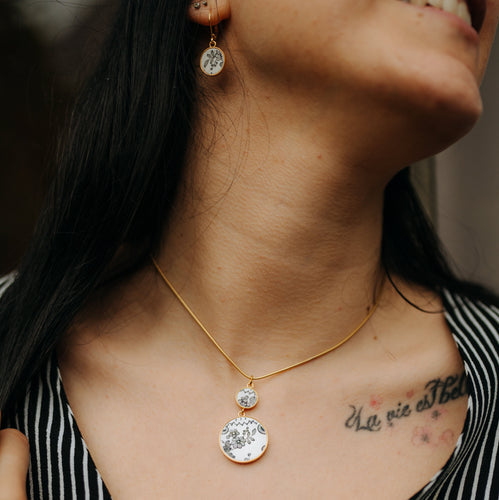
The result of this hard work? High-end jewelry (earrings, necklaces, bracelets, brooches), entirely handmade, which combines the nobility of ancient earthenware with a resolutely contemporary design.
Stories within the story
Each of Clélia's creations tells a story. Sometimesit's the story of a family , like a client who entrusted her with a plate to be turned into a pendant to celebrate her sister's 60th birthday.

Photo credit: Stevan Lira
At other times, it is the plates themselves that speak, like these "talking plates" or "rebus plates" from the 19th century that Clélia transforms into unique brooches .
"I love these plates, they remind me of childhood memories."
A revelation by the water's edge
But perhaps the most fascinating story is that of Clélia herself. It all began in her garden, by the Vézanne stream. Knowing that the old potters often threw their waste into this waterway, Clélia and her family decided one day to play at being amateur archaeologists.
/regions/2025/01/09/visuel-article-6-677ff65a1ae4e401775025.jpg)
It was at the bottom of the Vézanne stream that Clélia made a discovery that would change her life: a piece of an old inkwell created by Léon Pouplard, a famous earthenware maker from Malicorne. • © Les Nouveaux Jours Productions.
"We knew that in the past, ceramists threw earthenware scraps into the Vézanne River. That's what made me want, at one point, to go and do some digging here, by the river. It was a treasure hunt with my children."
And It was there, at the bottom of the stream, that she made a discovery that would change her life: a piece of an old inkwell created by Léon Pouplard, a famous earthenware maker from Malicorne.
"I had a revelation the moment I found this piece of old earthenware with this character that I now wear."
 Photo credit: Atelier Vézanne.
"This is the initial prototype. And this character has been with me since the beginning of the project. It's my little lucky charm."
In the 19th century, no fewer than seven earthenware factories were the pride of this small town, their chimneys belching smoke day and night, testifying to their ceaseless activity.
A bridge between past and future
Clélia perfectly embodies the spirit of Malicorne: she honors the past while creating the future. Her unique creations are a living testament to the history of earthenware, transformed into contemporary jewelry, each piece telling a story.
Every time she picks up an antique plate, Clélia doesn't just see an object, she sees infinite possibilities.
She remembers the hands that shaped this plate decades, even centuries ago. She sees the family meals, the celebrations, the moments of joy and sadness that this plate may have witnessed. And she sees the future: the smile of a woman wearing a unique pendant, the sparkle in the eyes of a collector discovering an extraordinary brooch.

"Necklace for 30 cents" - Private Collection - Photo credit: Extra Studio.
The legacy of Malicorne: a story of land and water
Malicorne-sur-Sarthe is not a village like any other. The moment you set foot there, you can feel the pulse of the artisans who, generation after generation, have forged its renown. In the 19th century, no fewer than seven earthenware factories were the pride of this small town, their chimneys belching smoke day and night, a testament to their ceaseless activity. But why Malicorne?
The answer lies in the very nature of this place, blessed by the gods of craftsmanship: clay, wood for the kilns, and the Sarthe River for transporting goods. It is thanks to this perfect combination that Malicorne became the undisputed capital of openwork earthenware.
This unique technique, in which ceramics are delicately cut to resemble lace, has become the city's signature. Each piece created in this way is a testament to the patience and skill of local artisans.
Malicorne earthenware is particularly known for its openwork technique, which gives the pieces a delicate appearance. This distinctive feature continues to attract art lovers and collectors.
 "Eclore" necklace made by Clélia from the Vézanne workshop. Photo credit: Extra Studio.
A former potter, now working in her workshop in Malicorne, Clélia does more than just create jewelry. She weaves connections between eras, gives new life to forgotten objects, and perpetuates ancestral know-how while propelling it into the 21st century.
So, the next time you pass through Malicorne-sur-Sarthe, listen closely. Perhaps you will hear, above the murmur of the river, the delicate tinkling of Clélia 's jewelry, singing the eternal story of reinvented earthenware.
► Watch it on france.tv in our "Envie Dehors" collection!